Fifty pence an hour.
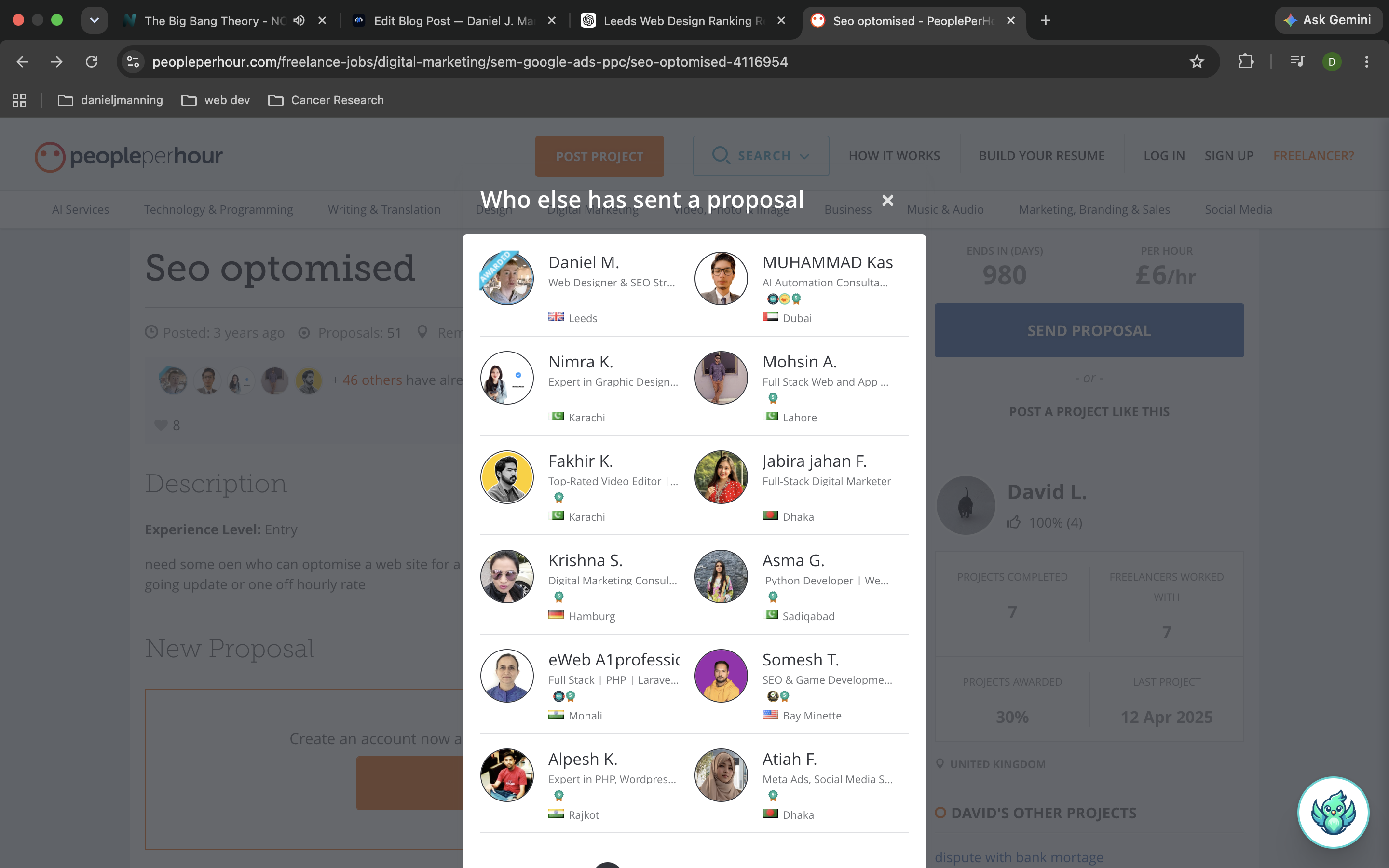
That's roughly what I paid myself to design and build one of my first freelance websites.
The project paid £50. By the time I was finished designing, building, revising and generally spending far more time on it than any £50 project had a right to consume, I'd put somewhere around 100 hours into the thing.
It wasn't an award-winning website. Looking back at it now, there are plenty of decisions I'd make differently. The client supplied the content, I was still developing my skills, and the finished product doesn't come close to representing the kind of work I produce today.
But that's not really the point.
Being inexperienced didn't make 100 hours of my time worth £50. What I hadn't understood yet was that pricing a website isn't just putting a number on some HTML, CSS or a WordPress installation. You're pricing the planning, design, problem-solving, revisions, communication, responsibility and—most obviously—the hours of your life required to actually deliver it.
A few years later, that £50 project is probably one of the best examples I have of how not to price creative and technical work.
So, with the benefit of hindsight—and some slightly painful maths—here's what the most expensive £50 I ever earned taught me.
The project I thought was a breakthrough
At the time, I didn't look at this project and think, I've just worked for fifty pence an hour.
I was excited.
I was still trying to establish myself as a web designer, working primarily with WordPress, and getting a real business website into my portfolio felt more important than calculating whether the project made financial sense.
And to be fair to my past self, I was proud of it.
I found an old Facebook post from 9 January 2024 where I described Helen's Hair as:
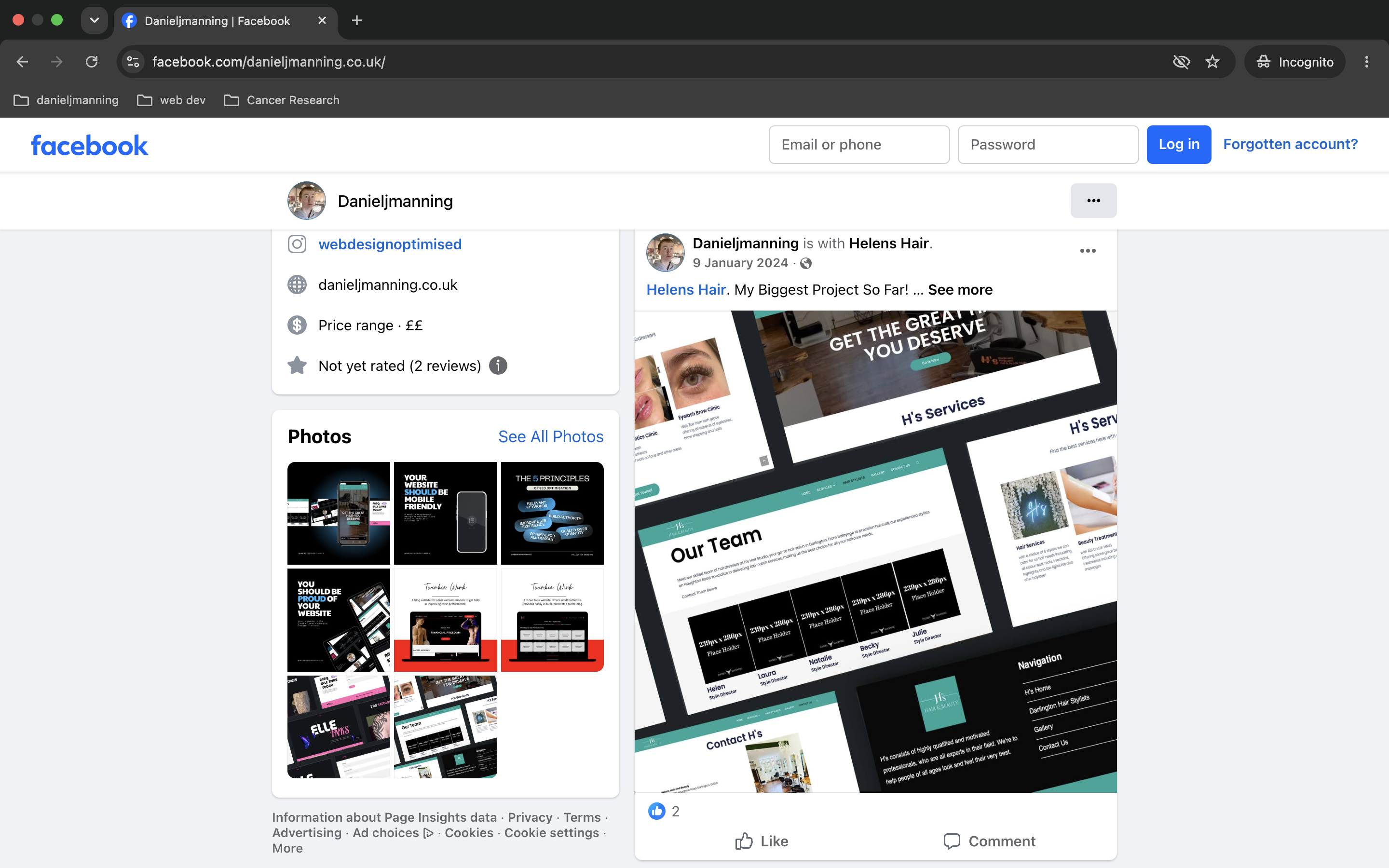
“My Biggest Project So Far!”
That probably says more about where I was in my career than anything else could.
I was sharing responsive mockups, putting the project into my PeoplePerHour portfolio and using it as evidence that I could build websites for actual businesses. I wasn't looking at it through the eyes I have now. I was looking at it as someone trying to prove that he could do this professionally.
And in one respect, it worked.
I had a real project. A real client. A live website. Something I could finally point at and say:
I built that.
The problem was that I'd completely disconnected the value of getting that experience from the value of my time.
£50 wasn't the scope. It became the budget for everything.
The client supplied the content, so this wasn't 100 hours of copywriting, brand strategy and development from scratch.
But there is still a lot between “here are the words” and “here is a functioning website.”
There was the design. Building the pages. Making everything responsive. Working through revisions. Fixing things. Testing things. Communicating with the client. Going back into the site because I'd noticed something else I wanted to improve.
And, because I was inexperienced, I was slower.
That's an important distinction.
I wouldn't need 100 hours to produce that website today.
But being slower because you're learning doesn't make those hours imaginary.
I had effectively sold a project for £50 and then allowed the amount of work attached to that £50 to expand almost without limit.
The maths is painful:
£50 ÷ 100 hours = £0.50 per hour.
And that's before thinking about any costs associated with doing freelance work.
I could have worked for ten hours and already been charging only £5 an hour.
Twenty-five hours would have taken me to £2.
Fifty hours: £1.
Somehow I kept going until I'd halved even that.
The ridiculous thing is that the client was happy
 The project wasn't some catastrophic client relationship that ended with everyone furious.
Quite the opposite.
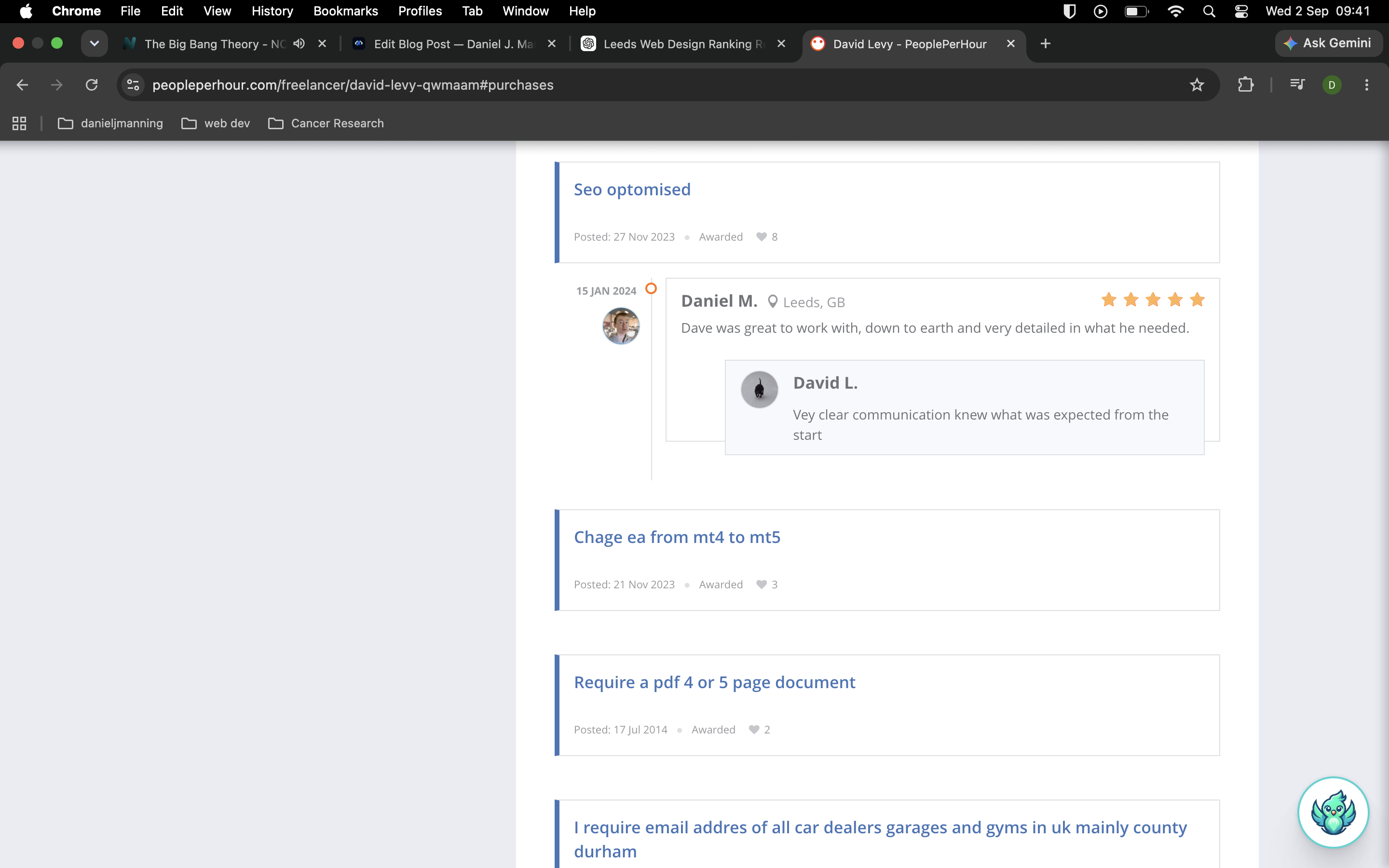
I recently found my old PeoplePerHour profile again. The feedback from the client, dated 15 January 2024, reads:
“highly recommend did much more than what was asked”
Five stars.
My own review of the client was positive too. I described him as easy to work with, down to earth and clear about what he needed.
So this isn't an article about a nightmare client who forced me to work for nothing.
I did that bit to myself.
“Did much more than what was asked” sounds fantastic in a review.
Commercially, however, there's another way to read it:
I had sold a £50 project and then repeatedly provided work that wasn't reflected in the price.
Going above and beyond can be excellent customer service.
Going above and beyond until you're earning fifty pence an hour is not customer service.
It's an inability to control scope.
There's a difference.
I confused being inexperienced with being worthless
I think this was the real problem.
When you're new, charging proper money can feel almost dishonest.
You know there are developers with ten or twenty years of experience. You know your designs aren't perfect. You know you're still Googling things. You know a more experienced developer could probably accomplish the same task faster.
So you tell yourself:
Who am I to charge hundreds of pounds for this?
My answer at the time was apparently:
Fine. £50 then.
That's the wrong conclusion.
Experience absolutely affects price. I wouldn't claim that the work I produced then had the same commercial value as the work I can produce today.
But there is an enormous distance between:
“I'm relatively inexperienced, so my pricing should reflect that.”
and:
“One hundred hours of my labour is worth £50.”
Those are not remotely the same proposition.
You can be junior without making yourself practically free.
The website isn't particularly good
I can say that now.
There are things in those old screenshots that make present-day me want to reach backwards through time and open DevTools.
The typography could be better. The hierarchy could be stronger. Some of the layouts are basic. The overall design is recognisably an early WordPress project.
That's fine.
I don't want to pretend everything I've ever made was secretly brilliant.
In fact, I think developers do themselves a disservice when they quietly delete every piece of old work that no longer meets their standards.
This project demonstrates something my current portfolio can't:
where I started.
I was proud enough of it at the time to put it prominently in my portfolio. I made marketing graphics featuring it. I shared responsive versions on social media. I used it to advertise myself as a WordPress web designer.
Looking at those materials now is almost like looking at another developer's portfolio.
And that's exactly why I'm glad I found them.
What I build now is completely different
A few years later, my process bears very little resemblance to the one behind that £50 website.
I'm no longer thinking about a website as a collection of WordPress pages that need to look decent.
I'm thinking about information architecture, user journeys, accessibility, responsive behaviour, reusable design systems, performance, security, maintainability and what the business actually needs the interface to accomplish.
My current work can involve Figma and UI/UX design before development begins.
On the engineering side, I'm now building with technologies such as Go, server-rendered HTML, HTMX, SQLite and semantic vanilla CSS.
I'm writing tests.
I'm using CI/CD.
I'm deploying containerised applications.
I'm implementing CSP, CSRF protection, authentication, canonical URLs, structured data, sitemaps, accessibility considerations and performance auditing.
My current portfolio itself is a full-stack application with its own internal workspace rather than a static collection of screenshots.
None of that means WordPress is inherently bad.
It means I've changed.
And if the work has changed this much, it would be absurd for the way I value that work not to change with it.
Design is work too
This is something else I didn't properly understand.
It's very easy to count the development hours because they feel tangible.
You wrote code for three hours. That's three hours of work.
Design somehow gets treated differently.
An hour in Figma trying different layouts?
Work.
Figuring out why a page doesn't feel balanced?
Work.
Planning how information should be structured?
Work.
Making desktop, tablet and mobile experiences coherent?
Work.
Talking to the client to understand what they're actually trying to achieve?
Also work.
A client isn't just buying the moment you type:
<h1>Hello world</h1>
They're buying the thinking required to know what should be built in the first place.
That's particularly relevant to how I want to approach client work now because I'm not interested in simply taking somebody's instructions and turning them into HTML.
I want to design and engineer the product.
That has to be reflected in the scope and the price.
A £1,000 project isn't automatically expensive
This is perhaps the strangest adjustment for me.
After charging £50, quoting £1,000 for a website can sound enormous.
It's twenty times the price.
But take a hypothetical bespoke project involving:
discovery and requirements; sitemap and information architecture; UI/UX design in Figma; responsive design; development; accessibility; performance optimisation; technical SEO; testing; deployment; revisions and communication.
Suppose that takes 50 hours.
£1,000 works out at £20 an hour before accounting for all the unpaid parts of freelancing: finding clients, writing proposals, administration, software, downtime, support and everything else involved in running the work.
Suddenly £1,000 doesn't sound outrageous.
Depending on the scope, it can sound cheap.
That's the mindset shift I'm still getting used to.
Price isn't a measure of how guilty I feel asking for money.
It's a function of what I'm agreeing to deliver.
Scope is probably more important than price
If I could teach my 2023 self one thing, it wouldn't simply be:
Charge more.
It would be:
Define what they're buying.
A £500 website doesn't need to contain £2,000 worth of work because I feel uncomfortable saying no.
If somebody has a smaller budget, that's completely fine.
The solution is a smaller scope.
Maybe fewer pages.
Maybe the client provides an established design.
Maybe there are fewer revision rounds.
Maybe advanced functionality comes later.
What I won't do again is solve a budget mismatch by silently donating dozens of additional hours.
If the scope grows, the quote changes.
If the budget can't change, the scope doesn't grow.
That sounds painfully obvious written down.
Apparently it took me approximately 100 hours to learn it.
Keep evidence of your work
There was another lesson I didn't appreciate until later: keep records.
I've spent part of writing this article digging through pieces of my old online presence.
My original PeoplePerHour profile is still publicly accessible.
It contains the H's Hair & Beauty project in my portfolio.
The client's PeoplePerHour history contains the project we worked on.
The original listing was posted on 27 November 2023.
The feedback is dated 15 January 2024.
My old Facebook business page contains posts from that same period showing the website, including one from 9 January 2024 explicitly describing Helen's Hair as my biggest project at the time.
Finding all of that years later has been strangely reassuring.
Today I'd have considerably more.
My work now goes through Git.
My commits can be cryptographically signed.
The repository contains an incremental history of how something was built rather than just the final product.
Client work will have proper agreements covering scope, payment, intellectual property and portfolio rights.
I don't want to rely on an old Facebook post surviving indefinitely to establish what I worked on.
That's another thing fifty quid taught me.
About credit
At some point after my involvement with the project ended, the attribution on the live website changed.
I'm deliberately not turning this article into a dispute about another person or company. That's not what this piece is about, and I'm not interested in naming anybody.
What matters to me is the lesson.
When I worked on the project, I didn't think particularly deeply about preserving authorship records, defining intellectual-property terms or documenting what happened after handover.
Now I do.
That doesn't mean plastering my name over every client's website forever.
It means having an agreement that answers basic questions before the work begins:
Who owns the bespoke deliverables?
What happens to reusable code I've developed independently?
When does ownership transfer?
Can I show the project in my portfolio?
Is developer attribution included?
What happens after handover?
Those aren't cynical questions.
They're professional ones.
The client wasn't the mistake
I want to make this especially clear because hindsight makes it very easy to rewrite history.
The client gave me positive feedback.
I gave the client positive feedback.
I was excited about the project.
I voluntarily put more time into it than the price justified.
So I'm not interested in portraying myself as somebody who was helplessly exploited for 100 hours.
The uncomfortable lesson is more useful:
I didn't know how to value or control my own work.
That's something I could change.
And I have.
The most expensive £50 I ever earned
Would I build that website today?
No.
Would I charge £50 for it?
Absolutely not.
Would I erase it from my history because I can design and engineer something substantially better now?
Also no.
That slightly awkward old WordPress site represents an important point in my career.
I was trying.
I had convinced somebody to trust me with a real business website.
I delivered it.
The client was happy enough to leave me five stars and say I'd done more than was asked.
And then I learned, eventually, that “doing more than was asked” needs limits when you're running a business.
The £50 wasn't a waste because the project was worthless.
It was expensive because of what I gave away to earn it.
Roughly 100 hours.
A lot of unnecessary stress.
And a very effective lesson in pricing.
Today, when I look at the work I'm producing and start feeling uncomfortable about charging hundreds or thousands of pounds for a bespoke project, I have a useful reference point.
I know what the alternative looks like.
It looks like fifty pence an hour.
I'm not doing that again.
To make the comparison more concrete, I rebuilt the same kind of salon website using the way I work today.

This isn't a redesign commissioned by the original client, and it doesn't reuse their content. It's a fictional salon concept built to show how differently I now approach design, responsive behaviour, accessibility and development.
The live demo is hosted on Render's free tier, so the first load may take a few seconds if the service is asleep.